


Barcelona Spent the Summer Ignoring the One Problem That Just Cost Them
Barcelona spent over €160m this summer and let Araújo go without replacing him. PSG exposed what was left, and the club is already planning for January.
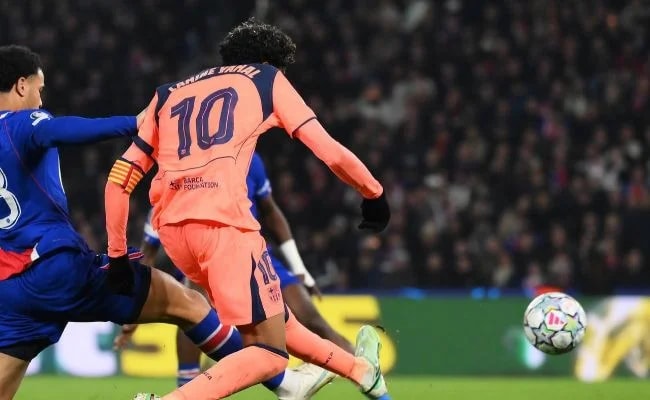
Barcelona lost 4-2 at Paris Saint-Germain on Tuesday night. If you want to know why, look at the player ratings for their back four.
On Google's post-match ratings, Gerard Martín finished on 4.5 and goalkeeper Joan García on 4.7. Pau Cubarsí got 5.5 and João Cancelo 5.7. Those were four of the five lowest marks on the pitch.
Ratings are somebody's judgement rather than a hard number. But a back four marked that far below everyone else is telling you something is wrong.
The one Barcelona defender who came out of it well was Xavi Espart. He rated 6.8, scored a goal, and was making his Champions League debut. He is just 19 years old.
This is the part that should bother Barcelona fans. They had the money this summer and they spent it.
For the first time since 2022, the club met La Liga's financial rules. They could buy properly again, and they did. ESPN put the summer's outlay at more than €160m across five arrivals.
Anthony Gordon arrived from Newcastle, reported at €70m plus add-ons by some outlets and €80m by others. Rodri came from Manchester City for €60m after Barcelona beat Real Madrid to his signature. Karim Adeyemi cost €22m. Gabriel Jesus came in late for €10m.
Every one of those is an attacking or midfield signing. The only defender Barcelona added all summer was João Cancelo, on a free transfer, and he is a full-back who played left-back in Paris.
What Barcelona Failed to Address
Nobody can say this came out of nowhere. Barcelona spent the whole summer window being linked with centre-backs.
Spanish outlet Sport reported interest in Cristian Romero, Alessandro Bastoni, Nico Schlotterbeck and Evan Ndicka. Cope reported that Aymeric Laporte was formally offered to the club. Micky van de Ven's name came up more than once.
Being linked with a player is not the same as being able to sign him, and most of those names were never close. What the reports show is not opportunity but awareness.
In August, Sport reported that Flick and sporting director Deco both agreed an experienced centre-back would add real value to the squad. They just had other priorities.
The striker came first. If Barcelona spent big on an attacker, the centre-back would be a young player or a loan. They also needed to sell a defender before buying one, and nobody wanted to go.
Worse than that, they let one go. Ronald Araújo joined Liverpool on loan on 10 August, and Barcelona did not replace him.
So the window closed with one fewer centre-back than it opened with, and €160m spent on other parts of the team.
Paris is where that decision showed up, and the timing could not have been crueller.
Eric García went off injured against Real Betis on the Saturday before the match, ruled out for three to four weeks. Jules Koundé sprained his ankle in the same game. Andreas Christensen was already out with a thigh problem.
That left Flick with Pau Cubarsí as his only fit recognised centre-back. His partner was Gerard Martín, a converted left-back who had himself limped off at half-time against Betis and was not at full fitness.
Barcelona had the ball for 54% of the match and completed more passes at better accuracy. They took 20 shots, the same as PSG. On the numbers, this was an even game.
It was not an even game. PSG put 14 shots on target. Barcelona put nine. Joan García was busy from the first minute and the scoreline stayed respectable longer than it should have.
Goal's tactical breakdown of the match sets out how it happened. Luis Enrique was content to give Barcelona the ball and attacked in straight lines whenever he won it back. Achraf Hakimi drifted inside to make a 3-2-2-3 and the wingers stayed wide to pin Barcelona's full-backs.
Flick pushed his line almost to the halfway line. Goal's verdict is blunt: whenever PSG got past the first press they cut through the Barcelona back line in very few passes, and only a ten-save performance from Joan García kept the score down.
It is worth being precise about the goals, because they complicate the easy version of this story. Doué's opener came from a Yamal turnover near his own box. Lucas Hernández headed the second. The two that settled it, from Vitinha on 81 and Fabián Ruiz on 86, both came from midfielders arriving unmarked from deep as Barcelona chased a winner.
So nobody was simply outrun by a ball over the top. The space that killed Barcelona was between a midfield committed forward and a defence still holding near halfway, which is a problem of structure as much as personnel.
Barcelona equalised twice. Xavi Espart scored at the near post on 55 minutes after a one-two with Fermín López. Lamine Yamal made it 2-2 on 79 with a solo goal.
Then it fell apart in five minutes. Vitinha scored from distance on 81. Fabián Ruiz finished from a Hakimi pass on 86. Game over.
There is a fair argument against all of this, and it is worth putting properly.
Barcelona did address the defence. They just did it differently. Rodri is one of the best holding midfielders in the world and part of what he gives you is protection for the back four. That was €60m spent on the problem.
Flick then left him on the bench and started 19-year-old Marc Bernal next to Pedri. Rodri did not come on until the 59th minute.
The reason was Sunday. Barcelona play Real Madrid at Camp Nou, and a win puts them nine points clear in La Liga. Flick picked a team with that in mind.
So you can argue Barcelona had the cover and chose not to use it. That is reasonable, and Rodri's absence is a real part of why the back four looked so exposed.
But it also makes the point. If the defence only holds when one particular midfielder is on the pitch, then the defence is not what is holding it. That is a patch, not a settled back line.
The January admission
By Wednesday morning, Diario Sport reported that Barcelona had changed their stance and would go looking for a defender in January.
That is the club answering the question itself. You do not go shopping in January for a position you were happy with in September.
January is also a harder market than July. Fewer good defenders are available mid-season, the ones who are usually come with a reason, and a new centre-back would have to learn Flick's high line on the move rather than through a preseason.
None of the injuries are freak events either. Christensen has broken down repeatedly over two seasons. Flick's system, with its high line and heavy pressing, asks more of centre-backs than most.
A squad built that way needs depth in that position more than anywhere else. Barcelona went into October with less of it than they had in June.
None of this means Barcelona are in trouble. They are top of La Liga, they have six points in the Champions League, and their attack will frighten anyone.
But they went to Paris with one fit centre-back and a converted full-back beside him, and the best defender they had on the night was a 19-year-old playing his first game in the competition.
Real Madrid come to Camp Nou on Sunday. Eric García is still out, Koundé is a doubt, and Flick will pick from more or less the same defence, because there is no other one to pick.
Read also: Dembélé's Message Reveals PSG's Mentality Under Pressure
Read more: How football's financial rules actually work: PSR, SCR and FFP explained
People also read: 5 Players Who Said No to Major Transfer Opportunities This Summer
Comments (0)
Be the first to comment.